I burned my first three batches of Pan de Muerto before I understood what I was doing wrong. Not a little burned—I mean hockey puck burned, smoke-alarm-screaming, kitchen-smelling-like-a-bakery-fire burned. The recipe seemed simple enough, but something kept going sideways. The dough wouldn’t rise right, or it would puff up beautifully and then collapse into a dense, sad disk in the oven. Honestly, I almost gave up on it entirely.
But I kept coming back to the idea of orange blossom Pan de Muerto. The smell of those tiny white flowers—azahar, in Spanish—reminds me of my grandmother’s courtyard in Mexico City, where she’d sit with her coffee and the whole garden smelled like honey and citrus. I wanted that smell in my kitchen. I wanted to pull a loaf out of the oven that filled every corner of the house with that perfume.
So I kept trying. I read old Mexican baking blogs, watched videos from abuelas in Puebla, and finally called my Tía Rosa who’s been making this bread for forty years. She laughed when I told her about the burned batches. “You’re rushing the dough,” she said. “It needs time to tell you what it wants.” That clicked something in my brain. This bread isn’t about speed—it’s about patience, about letting the yeast and the orange blossom water do their slow, beautiful work together. This Best Orange Blossom Pan de Muerto: Soft & Fluffy Recipe is the result of all those failures and that one phone call.
Why You’ll Love This Recipe
This isn’t just another holiday bread recipe. I tested this Pan de Muerto at least a dozen times across different seasons, altitudes, and humidity levels before I felt confident sharing it. The dough behaves differently in winter versus summer—I learned that the hard way. But now I’ve got the ratios dialed in so you can make it year-round without guessing.
- Incredibly Soft & Fluffy: The texture is pillowy and tender, thanks to a technique called tangzhong (a cooked flour paste that locks in moisture). It stays soft for days, which is rare for yeast breads.
- Authentic Orange Blossom Flavor: Real orange blossom water gives this bread its signature floral aroma—not artificial extract, not orange juice. It’s the real deal, and it makes all the difference.
- Perfect for Día de Muertos: This bread is traditionally made for the Day of the Dead, but honestly, it’s too good to make only once a year. It’s wonderful for brunch, afternoon coffee, or dessert.
- Easy to Follow: I’ve broken down every step with troubleshooting notes. If you’ve never worked with yeast dough before, this recipe will walk you through it.
- Freezer-Friendly: You can freeze the baked bread or even the shaped dough for later. That means fresh Pan de Muerto whenever you want it.
The first time I pulled a perfect, golden loaf out of the oven, I actually teared up a little. The house smelled like my grandmother’s garden, and the bread was so soft it practically dissolved on my tongue. That’s the feeling I want you to have. This recipe is my best version—tested, tweaked, and perfected so you don’t have to burn a single batch.
What Ingredients You Will Need
This recipe uses simple, pantry-friendly ingredients, but a few of them are special. Don’t skip the orange blossom water—it’s what makes this bread taste like a memory. Here’s everything you’ll need, broken down by function.
For the Tangzhong (Flour Paste)
- 2 tablespoons bread flour (or all-purpose flour in a pinch)
- ¼ cup water (60 ml)
- ¼ cup whole milk (60 ml)
For the Dough
- 3 cups bread flour (360g, spooned and leveled—don’t scoop straight from the bag)
- ¼ cup granulated sugar (50g)
- 2 ¼ teaspoons active dry yeast (one packet, or 7g instant yeast)
- 1 teaspoon salt (fine sea salt, not table salt)
- 2 large eggs, room temperature
- ¼ cup whole milk (60 ml), warm (about 110°F)
- ¼ cup unsalted butter (57g), softened to room temperature
- 1 tablespoon orange blossom water (this is key—I use Cortas brand, it’s reliable)
- 1 teaspoon vanilla extract
- Zest of 1 orange (organic if possible, washed well)
For the Glaze & Topping
- ¼ cup granulated sugar (50g)
- ¼ cup fresh orange juice (about 1 orange)
- 1 teaspoon orange blossom water
- 2 tablespoons melted butter, for brushing
- ¼ cup granulated sugar, for sprinkling (mixed with ½ teaspoon orange zest if you’re feeling fancy)
A quick note on orange blossom water: you can find it in Middle Eastern grocery stores, Latin markets, or online. It’s usually near the rose water or baking aisle. Don’t confuse it with orange extract—they’re not the same thing. Orange blossom water is delicate and floral; orange extract is intense and artificial-tasting. I learned this the hard way when I accidentally used extract in my second batch and the bread tasted like a candle.
Equipment Needed
You don’t need a fancy bakery setup for this recipe, but a few tools will make your life easier.
- Stand mixer with dough hook: You can knead by hand, but it takes about 15-20 minutes of solid work. The mixer does it in 8 minutes. If you’re kneading by hand, prepare for an arm workout.
- Digital kitchen scale: I know, I know, another gadget. But measuring flour by weight is the single best way to get consistent results with yeast dough. A cup of flour can weigh anywhere from 120g to 150g depending on how you scoop it. That difference matters.
- Instant-read thermometer: Useful for checking water temperature (aim for 110°F) and internal bread temperature (190°F when done).
- Large mixing bowl: Glass or ceramic works best. Metal can conduct heat and mess with the dough temperature.
- Baking sheet: Lined with parchment paper or a silicone baking mat.
- Plastic wrap or a clean kitchen towel: For covering the dough while it rises.
- Pastry brush: For glazing the baked bread. A silicone brush is easier to clean than a natural bristle one.
I’ve made this bread with a cheap hand mixer (don’t recommend it) and even a bread machine on the dough setting (works in a pinch). But the stand mixer is my go-to. If you’re just starting out, borrow one from a friend or check Facebook Marketplace—people sell them all the time for cheap.
Preparation Method
Step 1: Make the Tangzhong
In a small saucepan, whisk together the bread flour, water, and milk until smooth. Cook over medium heat, stirring constantly, until the mixture thickens into a paste. This takes about 2-3 minutes. You’ll see streaks form on the bottom of the pan as you stir. Remove from heat and let it cool to room temperature. The tangzhong is what keeps this bread soft for days—it’s a game-changer.
Step 2: Activate the Yeast
In a small bowl, combine the warm milk (about 110°F—warm but not hot, like bathwater) with a pinch of sugar and the yeast. Stir gently and let it sit for 5-10 minutes until it gets foamy. If it doesn’t foam, your yeast might be dead. Don’t panic—just try again with fresh yeast. I’ve killed yeast with water that was too hot more times than I want to admit.
Step 3: Mix the Dough
In the bowl of your stand mixer, whisk together the bread flour, sugar, and salt. Add the cooled tangzhong, the foamy yeast mixture, eggs, softened butter, orange blossom water, vanilla extract, and orange zest. Mix on low speed with the dough hook until everything comes together into a shaggy dough. This takes about 2 minutes. Scrape down the sides of the bowl with a spatula.
Step 4: Knead
Increase the speed to medium-low and knead for 8-10 minutes. The dough should become smooth, elastic, and slightly tacky—not sticky. It should pull away from the sides of the bowl but still feel soft and pliable. If it’s too sticky, add a tablespoon of flour at a time. If it’s too dry, add a teaspoon of milk. The dough should pass the “windowpane test”: stretch a small piece of dough between your fingers until it’s thin enough to see light through without tearing.
Step 5: First Rise
Shape the dough into a smooth ball and place it in a lightly greased bowl. Cover with plastic wrap or a damp towel and let it rise in a warm, draft-free spot for 1.5 to 2 hours, until doubled in size. I usually put it in my oven with the light on (but the oven off). If your kitchen is cold, it might take closer to 2.5 hours. Don’t rush this—the flavor develops during the rise.
Step 6: Shape the Bread
Punch down the dough gently to release the air. Turn it out onto a lightly floured surface. Divide the dough into two pieces: one large piece (about 2/3 of the dough) for the main loaf, and one smaller piece for the decorations. Shape the large piece into a round loaf and place it on your prepared baking sheet.
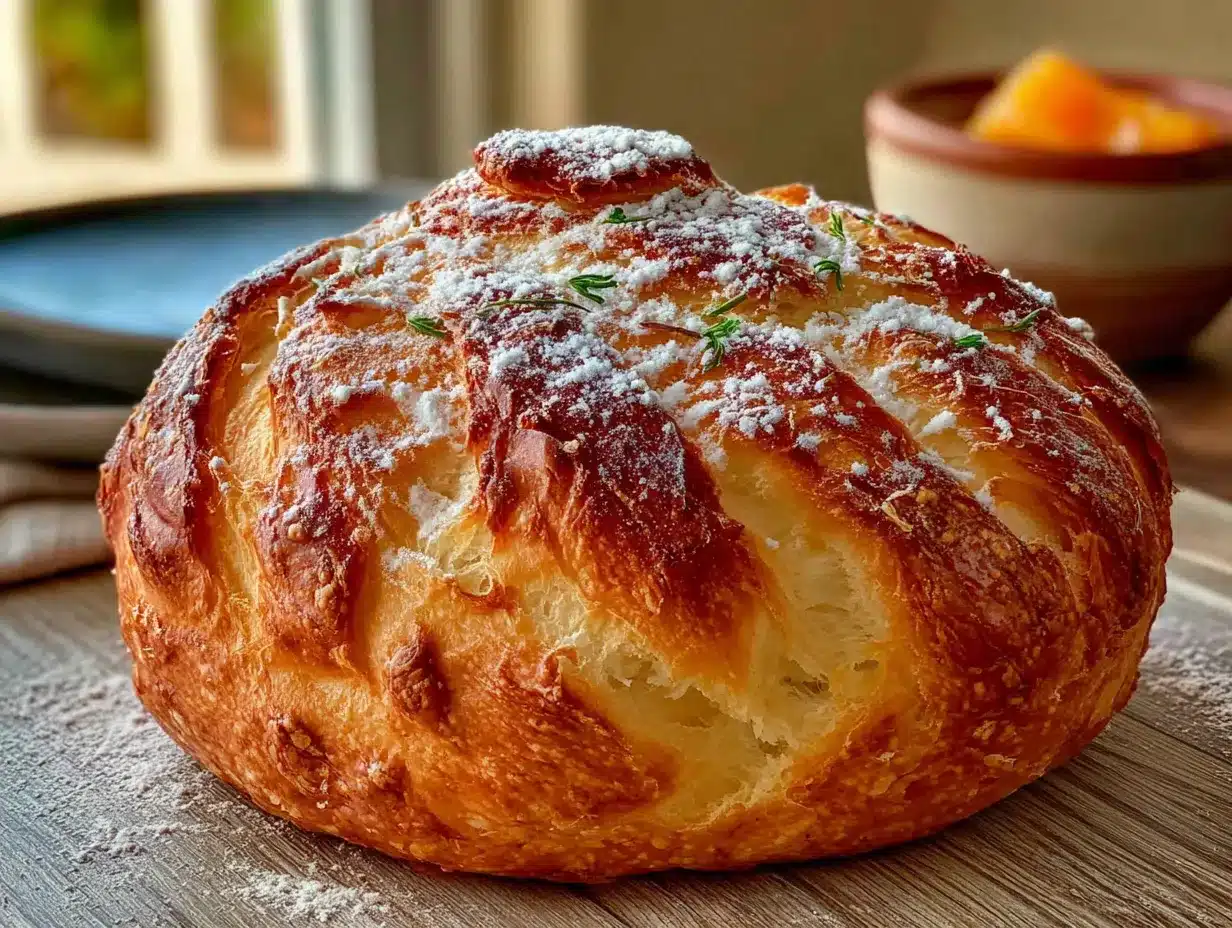
For the decorations, roll the smaller piece into a log and cut it into 4 equal pieces. Roll each piece into a rope about 6 inches long. Pinch the ends together to form a teardrop or bone shape—these represent the bones of the deceased in the traditional design. Place two ropes on top of the loaf to form an X, and the other two on the sides. Roll a small ball of dough for the top center (the “skull” or “knot”).
This part takes practice. My first attempt looked like a deformed octopus. But even imperfectly shaped Pan de Muerto tastes the same, so don’t stress about it.
Step 7: Second Rise
Cover the shaped loaf loosely with plastic wrap and let it rise for 45 minutes to 1 hour, until puffy and nearly doubled. It should feel light and airy when you gently poke it.
Step 8: Bake
Preheat your oven to 350°F (175°C). Bake the bread for 25-30 minutes, until the top is deep golden brown and the internal temperature reaches 190°F. If the top is browning too quickly, tent it loosely with aluminum foil halfway through.
Step 9: Glaze
While the bread bakes, make the glaze: combine the sugar, orange juice, and orange blossom water in a small saucepan. Heat over medium heat until the sugar dissolves, then simmer for 2 minutes until slightly syrupy. Remove from heat.
As soon as the bread comes out of the oven, brush it generously with the melted butter, then brush on the orange glaze. Sprinkle the sugar-orange zest mixture over the top while it’s still wet. Let the bread cool on the baking sheet for 10 minutes, then transfer to a wire rack to cool completely.
Cooking Tips & Techniques
I’ve made every mistake you can imagine with this bread, so let me save you some trouble.
Temperature is everything. Yeast is a living thing—it needs warmth, not heat. If your milk is over 120°F, you’ll kill the yeast. If your kitchen is under 65°F, the dough will take forever to rise. I keep a thermometer in my kitchen and adjust my rising time accordingly. In winter, I microwave a cup of water for 2 minutes, then put the dough bowl next to it in the microwave (door closed) to create a warm, humid environment.
Don’t skip the tangzhong. I know it’s an extra step. I know it seems fussy. But this cooked flour paste is what makes the bread stay soft for 3-4 days instead of getting stale overnight. It’s a technique from Japanese milk bread, and it works beautifully here.
Let the dough rest. After kneading, if the dough feels tight and resistant when you try to shape it, let it rest for 10-15 minutes. This relaxes the gluten and makes it much easier to work with. I learned this after wrestling with a dough that kept snapping back into a ball.
Watch the glaze. The sugar-orange juice glaze will harden as it cools, so brush it on while the bread is still warm. If it gets too thick, reheat it gently with a splash of water.
Variations & Adaptations
This recipe is flexible, and I’ve tried several variations over the years.
Dairy-Free Version: Substitute the whole milk with oat milk or almond milk, and use vegan butter. The texture will be slightly less tender, but still delicious. I tested this for a friend with dairy allergies, and it worked surprisingly well.
Orange-Anise Twist: Add 1 teaspoon of ground anise seed to the flour. It gives the bread a subtle licorice note that pairs beautifully with the orange blossom. My Tía Rosa swears by this combination.
Chocolate Orange Blossom: Fold in ½ cup of mini chocolate chips after the dough is kneaded. The chocolate melts into little pockets of richness against the floral dough. This one is dangerous—I ate half a loaf in one sitting.
Mini Loaves: Divide the dough into 8 equal pieces and shape into small rounds. Skip the decorations and bake for 15-18 minutes. Perfect for gifting or freezing individual portions.
Savory Version: Omit the sugar and orange blossom water, add 2 teaspoons of dried rosemary and 1 cup of shredded Manchego cheese. Brush with garlic butter instead of the sweet glaze. I made this for a friend who doesn’t like sweet bread, and it was a hit.
Serving & Storage Suggestions
Pan de Muerto is best served warm, but it’s wonderful at room temperature too. The orange blossom aroma is strongest when the bread is fresh, so I recommend eating it within the first 24 hours if possible.
For serving, slice it thick and serve with hot coffee, Mexican hot chocolate, or atole. It’s also perfect for dunking in a cup of café de olla—the cinnamon and piloncillo flavors match the orange blossom beautifully.
To store, wrap the cooled bread tightly in plastic wrap and keep it at room temperature for up to 4 days. Do not refrigerate—the fridge will dry it out. If it starts to feel stale, microwave a slice for 10 seconds to bring back some softness.
For freezing, wrap the fully cooled bread in plastic wrap, then foil, and freeze for up to 3 months. Thaw at room temperature overnight. You can also freeze the shaped, unbaked dough after the second rise. Just wrap it tightly and freeze. When you’re ready to bake, thaw it in the refrigerator overnight, then let it come to room temperature for 30 minutes before baking.
The flavor actually improves on the second day—the orange blossom water has time to mellow and meld with the other ingredients. So don’t be disappointed if you can’t eat it all on day one.
Nutritional Information & Benefits
This is a celebration bread, so it’s not exactly health food. But it does have some redeeming qualities.
Per serving (1/8 of the loaf): approximately 280 calories, 8g fat, 45g carbohydrates, 6g protein, 2g fiber, 15g sugar. These are estimates and will vary based on exact ingredients and portion size.
Orange blossom water has been used in traditional medicine for its calming properties—it’s said to help with anxiety and promote restful sleep. The orange zest provides a small amount of vitamin C and antioxidants. And the bread itself is made with real butter and eggs, which means it has more protein and healthy fats than your average supermarket bread.
If you’re watching your sugar intake, you can reduce the sugar in the dough to 2 tablespoons and skip the glaze. The bread will still be soft and flavorful, just less sweet.
This recipe contains gluten, dairy, and eggs. For a gluten-free version, I recommend using a good 1-to-1 gluten-free flour blend, but I haven’t tested that myself, so proceed with caution.
Conclusion
This Best Orange Blossom Pan de Muerto: Soft & Fluffy Recipe is more than just a bread recipe to me. It’s the result of burned batches, a phone call to my Tía Rosa, and the smell of azahar that I’ve been chasing since I was a kid. It’s the bread I make when I want to feel connected to my family, to my culture, and to the people I’ve loved and lost.
I hope you make it for your own Día de Muertos celebration, or just for a Tuesday morning when you need something beautiful and fragrant on your table. Don’t worry if your decorations look a little wonky—mine still do sometimes. The bread will taste just as good. And honestly, the imperfect ones are the most memorable.
If you make this recipe, I’d love to hear about it. Leave a comment below and tell me how it turned out, or tag me in your photos. Did you add a twist? Burn a batch or two? Share your story—that’s what this bread is really about.
Frequently Asked Questions
Can I use all-purpose flour instead of bread flour?
Yes, you can. The bread will be a little less chewy and might not rise quite as high, but it will still be soft and delicious. If you use all-purpose flour, reduce the liquid by 1-2 tablespoons since it absorbs less water than bread flour.
Where can I find orange blossom water?
Look for it in Middle Eastern grocery stores, Latin markets, or the international aisle of well-stocked supermarkets. You can also find it online. Cortas and Nielsen-Massey are reliable brands. Avoid anything labeled “orange extract”—it’s not the same thing.
My dough isn’t rising. What went wrong?
Most likely the yeast was dead or the liquid was too hot. Check the expiration date on your yeast and make sure your milk is around 110°F—warm but not hot. If your kitchen is cold, find a warmer spot or use the oven-with-the-light-on trick I mentioned earlier.
Can I make this ahead of time?
Absolutely. You can bake the bread a day ahead and store it wrapped at room temperature. Or freeze the baked bread for up to 3 months. The glaze will soften slightly after freezing, so you might want to refresh it with a quick brush of warm glaze before serving.
What does Pan de Muerto taste like?
It’s a soft, slightly sweet bread with a delicate floral aroma from the orange blossom water. The texture is similar to brioche but less rich and buttery. The glaze adds a subtle citrus sweetness and a light crunch from the sugar topping. It’s comforting, fragrant, and not overly sweet—perfect with coffee or hot chocolate.
Pin This Recipe!
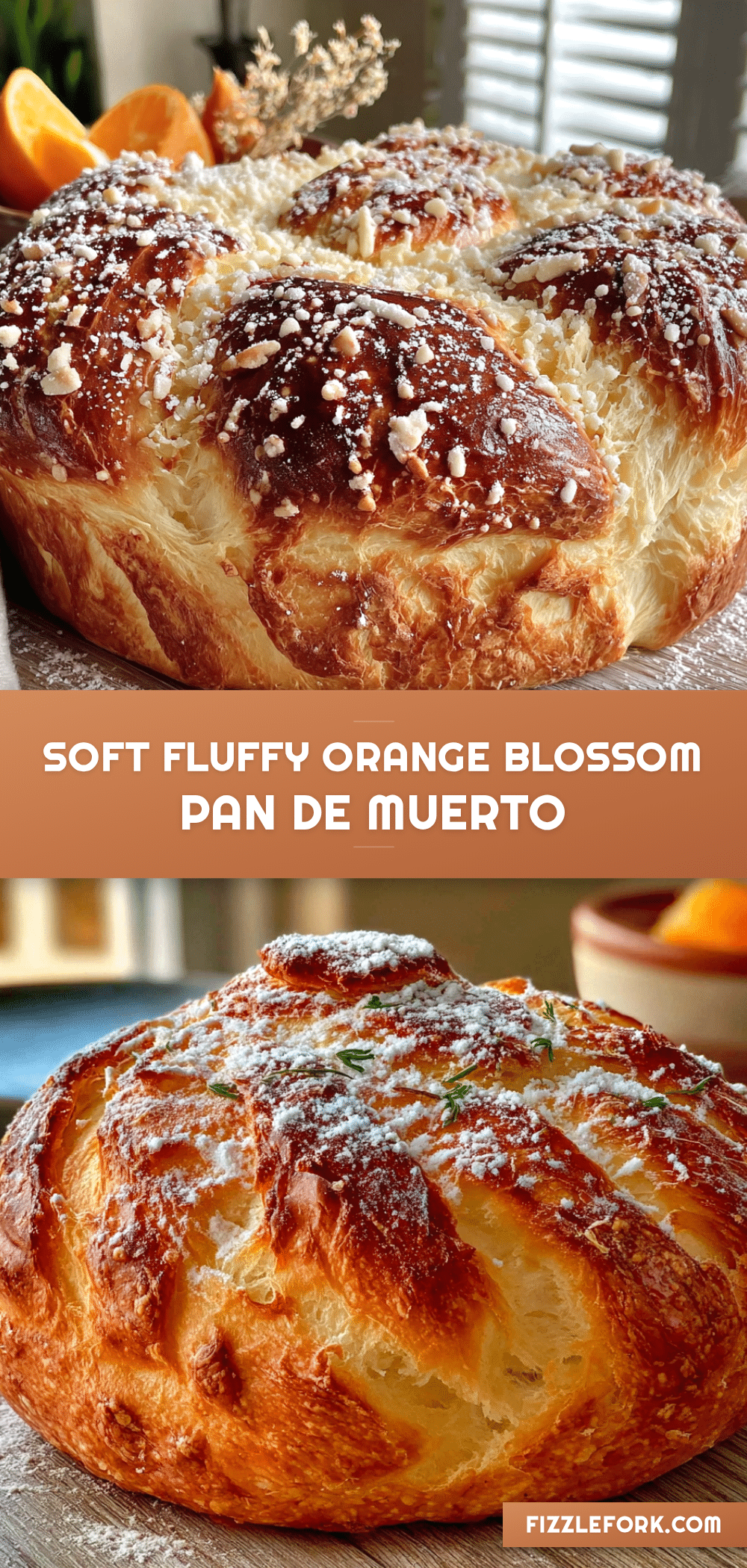
Best Orange Blossom Pan de Muerto: Soft & Fluffy Recipe
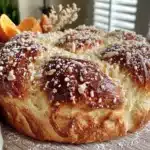
This soft and fluffy Pan de Muerto is infused with authentic orange blossom flavor and made using the tangzhong technique for a pillowy texture that stays fresh for days. Perfect for Día de Muertos or any occasion, this recipe includes detailed instructions and troubleshooting tips to ensure success.
- Prep Time: 30 minutes
- Cook Time: 30 minutes
- Total Time: 3 hours 30 minutes (including rising time)
- Yield: 8 servings 1x
- Category: Bread
- Cuisine: Mexican
Ingredients
- 2 tablespoons bread flour (for tangzhong)
- ¼ cup water (60 ml, for tangzhong)
- ¼ cup whole milk (60 ml, for tangzhong)
- 3 cups bread flour (360g, spooned and leveled)
- ¼ cup granulated sugar (50g, for dough)
- 2 ¼ teaspoons active dry yeast (one packet, or 7g instant yeast)
- 1 teaspoon fine sea salt
- 2 large eggs, room temperature
- ¼ cup whole milk (60 ml), warm (about 110°F)
- ¼ cup unsalted butter (57g), softened to room temperature
- 1 tablespoon orange blossom water
- 1 teaspoon vanilla extract
- Zest of 1 orange (organic if possible)
- ¼ cup granulated sugar (50g, for glaze)
- ¼ cup fresh orange juice (about 1 orange)
- 1 teaspoon orange blossom water (for glaze)
- 2 tablespoons melted butter (for brushing)
- ¼ cup granulated sugar (for sprinkling, mixed with ½ teaspoon orange zest if desired)
Instructions
- Make the tangzhong: In a small saucepan, whisk together 2 tablespoons bread flour, ¼ cup water, and ¼ cup milk until smooth. Cook over medium heat, stirring constantly, until thickened into a paste (about 2-3 minutes). Remove from heat and let cool to room temperature.
- Activate the yeast: In a small bowl, combine warm milk (about 110°F) with a pinch of sugar and the yeast. Stir gently and let sit for 5-10 minutes until foamy.
- Mix the dough: In the bowl of a stand mixer, whisk together 3 cups bread flour, ¼ cup sugar, and salt. Add the cooled tangzhong, foamy yeast mixture, eggs, softened butter, orange blossom water, vanilla extract, and orange zest. Mix on low speed with the dough hook until a shaggy dough forms (about 2 minutes). Scrape down the sides.
- Knead: Increase speed to medium-low and knead for 8-10 minutes until smooth, elastic, and slightly tacky. The dough should pass the windowpane test. If too sticky, add flour a tablespoon at a time; if too dry, add milk a teaspoon at a time.
- First rise: Shape dough into a smooth ball and place in a lightly greased bowl. Cover with plastic wrap or a damp towel and let rise in a warm, draft-free spot for 1.5 to 2 hours, until doubled in size.
- Shape the bread: Punch down the dough and turn out onto a lightly floured surface. Divide into two pieces: about 2/3 for the main loaf and 1/3 for decorations. Shape the large piece into a round loaf and place on a parchment-lined baking sheet. For decorations, roll the smaller piece into a log, cut into 4 equal pieces, roll each into a 6-inch rope, and pinch ends to form teardrop or bone shapes. Place two ropes on top to form an X and the other two on the sides. Roll a small ball for the top ce…
- Second rise: Cover the shaped loaf loosely with plastic wrap and let rise for 45 minutes to 1 hour, until puffy and nearly doubled.
- Bake: Preheat oven to 350°F (175°C). Bake for 25-30 minutes until deep golden brown and internal temperature reaches 190°F. Tent with foil if browning too quickly.
- Make the glaze: While bread bakes, combine ¼ cup sugar, orange juice, and 1 teaspoon orange blossom water in a small saucepan. Heat over medium until sugar dissolves, then simmer for 2 minutes until slightly syrupy. Remove from heat.
- Glaze: As soon as bread comes out of the oven, brush generously with melted butter, then brush on the orange glaze. Sprinkle the sugar-orange zest mixture over the top while still wet. Cool on baking sheet for 10 minutes, then transfer to a wire rack to cool completely.
Notes
Temperature is crucial: milk should be around 110°F to activate yeast without killing it. Don’t skip the tangzhong—it keeps the bread soft for days. If dough feels tight after kneading, let it rest 10-15 minutes before shaping. Brush glaze while bread is still warm for best results. Bread can be frozen for up to 3 months.
Nutrition
- Serving Size: 1 slice (1/8 of loaf
- Calories: 280
- Sugar: 15
- Sodium: 250
- Fat: 8
- Saturated Fat: 4
- Carbohydrates: 45
- Fiber: 2
- Protein: 6
Keywords: Pan de Muerto, orange blossom, Day of the Dead bread, Mexican sweet bread, tangzhong, soft bread, holiday bread